Compiled by Roger Edwards, Special Projects Officer, Glasgow Zoopark, December 2000
4. Constructing the new zoo
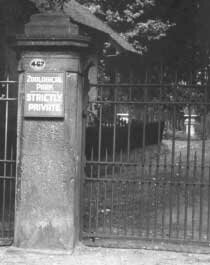
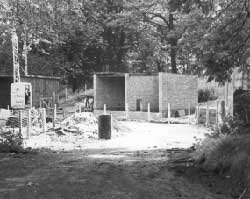
A photograph of the old main gate on the Hamilton Road shows the roof of the Swiss chalet lodge with its urns. Sydney Benson labelled the picture
' The main gate at Calderpark Estate, Broomhouse. Joiners and painters have been busy erecting notice boards and erecting new gates. Work on the erection of the enclosure is expected to commence shortly .'
There is no indication when this picture was taken and because of the frustrating delays over construction of the Zoo it could date from any period between 1939 and 1946 - mid 1940s seems most likely.
Cutting the first turf took place on 31st May 1946. Work started at Calderpark on 3rd June. The annual report for that year says that:
'only ex-servicemen were engaged - seven, including a foreman - and the enclosing of the park was their first task. . . . About 30 acres have now been enclosed and roads and paths have been cut and laid. The quantity ofroad material used to date is nearly 2,000 tons. It must be appreciated that this work had to be completed before the building of enclosures and dens could be started. By mid-October the first enclosure was finished. This is in area about seven acres, and includes the loch .'
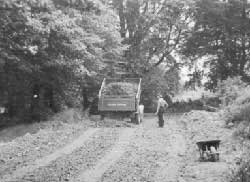
The deckhouse from a boat was placed in position on 2nd September 1946 and three days later it was duly inspected (see note ). On 3rd September road material for the main drive was delivered from Glasgow Corporation; this photograph is labelled looking east near compound.
looking east near compound
men working on the road
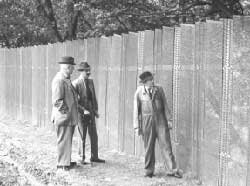
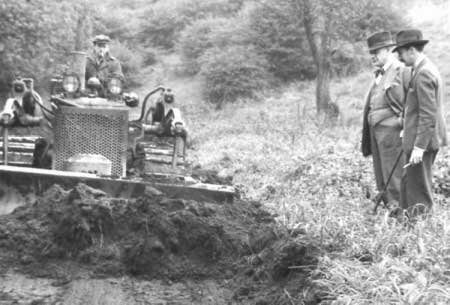
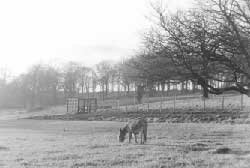
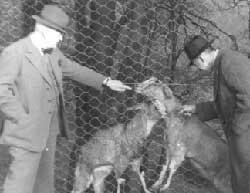
Another photograph taken on the same day shows men working on the road, along with pipe laying and the first cage. On 28th September 1946, the Earl of Dumfries and A. McNab Chassels were photographed on the site of the Children's Zoo (see note ). The next day they inspected a bulldozer cutting road at river on west, near golf course. An undated photograph shows Lord Dumfries and Mr Chassels inspecting a fence constructed from tank track (see note ).
The Earl of Dumfries and A. McNab Chassels on the site of the Children's Zoo
Fence constructed from tank track
The Earl of Dumfries and A. McNab Chassels inspecteing a bulldozer cutting road at river on west, near golf course.
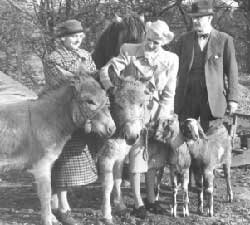
The annual report goes on to say that the first animals included eight Soay sheep, two donkeys, two Anglo-Nubian goats, two white swans, two ducks and one black swan. On 28th October 1946, Mr A. McNab Chassels (vice-president) was photographed with donkeys, goats and a horse. The two women have not been identified; the older one appears in other photographs and may be Mrs Chassels perhaps with a personality of the day. On 2nd January, 1947, the first aviary erected with A.R.P.(air raid precautions) doors was photographed, donkey and sheep in the foreground. This would appear to be near where the tree porcupine enclosure now is.
Mr A. McNab Chassels (vice-president) with donkeys, goats and a horse.
The first aviary erected with A.R.P.(air raid precautions) doors was photographed, donkey in the foreground.
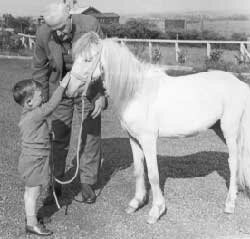
On 18th January, Sir Garrard Tyrwhitt-Drake was photographed looking at the now enlarged aviary and resident white peacock, and also with Mr Chassels looking at the Anglo-Nubian goats. Sir Garrard also donated animals, including a rare blue-eyed royal cream pony (see note ). The Society was still run from an office in Bothwell Street, as shown in a photograph of Sydney Benson and his secretary, Miss Marjorie Fraser, dated 25th April 1947 (see note ).
Sir Garrard Tyrwhitt-Drake looking at the now enlarged aviary and resident white peacock.
Mr Chassels looking at the Anglo-Nubian goats.
Sir Garrard also donated animals, including a rare blue-eyed royal cream pony
Sydney Benson and his secretary, Miss Marjorie Fraser
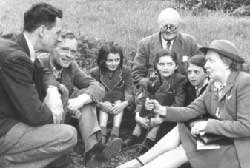
The same day the keeper Mr William Cunningham was photographed at Calderpark (see note ). We have a photograph of the BBC's Kathleen Garscadden (Aunty Kathleen ) dated 28th May 1947. The significance of this picture is not clear, but it does show Tom H. Gillespie (founder director of Edinburgh Zoo, in spectacles), Gilbert Fisher (father of Jerry Fisher who was director of Glasgow Zoo for a spell), and James Douglas Home (see note ).
Keeper Mr William Cunningham.
The BBC's Kathleen Garscadden (Aunty Kathleen ) Tom H. Gillespie (founder director of Edinburgh Zoo, in spectacles), Gilbert Fisher (father of Jerry Fisher who was director of Glasgow Zoo for a spell), and James Douglas Home
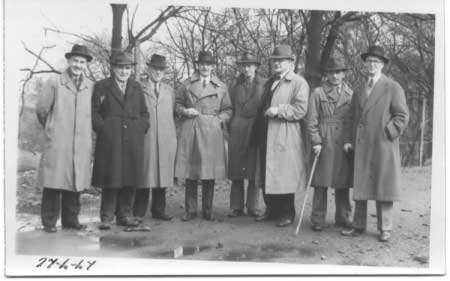
Some members of the Society's Council were photographed at Calderpark on Sunday 27th April 1947 - from left: James Morton, Strachan Kerr, Dr James Johnstone (vice-president), two unknown, A. McNab Chassels (vice-president), Sydney Benson (director-secretary) and Colonel T.H. Scott.
On 10th June 1947 vice-president A. McNab Chassels and the president, now titled the Marquis of Bute, were photographed in front of what eventually became the lion dens. A second photograph of these dens is dated 2nd July 1947 .
Vice-president A. McNab Chassels and the president, now titled the Marquis of Bute, in front of what eventually became the lion dens.
The dens
NOTES:
These notes come primarily from a taped interview with W.R.S. MacKenzie (Society President) and others in July 1987.
1. Deckhouse . The party inspecting the deckhouse on 5th September 1946 includes (from left) the Earl of Dumfries (president); Dr James Johnstone (vice-president); Sir Garrard Trywhitt-Drake; A. McNab Chassels (vice-president in bow tie); Dr Sneddon with pipe; Tom Gillespie (director of Edinburgh Zoo, hatless with glasses).
You could not get new building materials in 1946 because of the demand for rebuilding after bombing, so you had to buy second-hand materials. The deckhouse was the first workman's bothy. There were seven men employed by the Zoo, all ex-servicemen, and they did everything. From these second-hand materials they built the Zoo - it really was an achievement.
2. Old Children's Zoo . This is probably the area now occupied by the Barbary Sheep enclosure. The ground drops away to the far side of the road, and there was a rough drive, the route of the carriageway to the old Calderpark House.
3. Tank track fence . This could be a boundary fence between the North Calder River and where the Axis deer now are (in the 1990s to become the bird of prey arena). Richard O'Grady identified it as the boundary at the Broomhouse Hall.
4. Royal CreamPony . Caption on photograph: Many animals, which have been presented to the Society, are being given temporary homes. Here is a rare blue-eyed royal cream pony, at present with Mr A. McNab Chassels (vice-president). It was given by Sir Garrard Tyrwhitt-Drake, Maidstone. The zoo at Edinburgh is also keeping a few till Glasgow is ready for them.
5. Miss Marjorie Fraser : Caption on photograph : Glasgow Zoo Story: In their office, 11 Bothwell St, Glasgow, Director-Secretary Mr S.H. Benson and his secretary, Miss Marjorie Fraser, the Society's first employee, refer to a letter from their filing cabinet, the Society's first furniture.
6. Mr William Cunningham : Caption on photograph: Glasgow Zoo Story: Mr William Cunningham, Baillieston, who looks after the animals at Calderpark, gives 'Jock' the Australian black swan, the 'once over' after the severe weather. Jock is quite fierce and will allow no one to approach except Mr Cunningham, but to him he comes like a pet dog, 'begs' and wants to be fondled. The swan was a donation from the Hon. Kenneth Weir.
7. Kathleen Garscadden , known as Aunty Kathleen of the BBC was one of the fabulous characters of Scottish broadcasting; radio was her forte. Anybody in Scottish entertainment first appeared in Children's Hour under Aunty Kathleen. I don't recognise the children, but the men are: Tom H. Gillespie, the founder of Edinburgh Zoo and their first director is the one in spectacles, was known as the Zoo Man; Gilbert Fisher, known as Hut Man, became director of Edinburgh Zoo for quite a number of years; James Douglas Home, known as Bird Man, is on the left. For years the BBC did not have a proper recording of the hoot of a tawny owl in the middle of the night; they now do have it in their archives and Douglas Home did it - with his hands. It is the one they use to this day, on every owl recording they have ever done!
8. LionDens This is the beginnings of the lion cages, which were progressively developed. The outside run, which has the holding cages, but twice the size, was exposed to the open air. This outside run was very, very much smaller than the enclosure we have today. [ The date written on the photograph, 2nd July 1947, is probably a mistake as the Zoo opened just seven days later].